
People appearing on Jeffrey’s meticulously compiled artwork.
What strikes the visitor at first glance is the sparse and controversial use of people in Jeffrey Smart’s painting. Even the naked or half-naked young men have disappeared since the 1964 production with a large picture of the rear end of a young man which was shown at the exhibition at Galleria Ottantotto in April 1965 in Rome, San Cataldo I. Since then there are no more naked men, except Ian Bent in profile, but covered with a huge bath towel in The Dampier II, which was shown with numbers I and III on the previous page.
Classified as an urban landscape painter, but he more often than not put people in his y urban or suburban landscapes.
And what is the messages he delivers about these people and about their landscape? Let’s go and find out about his people.
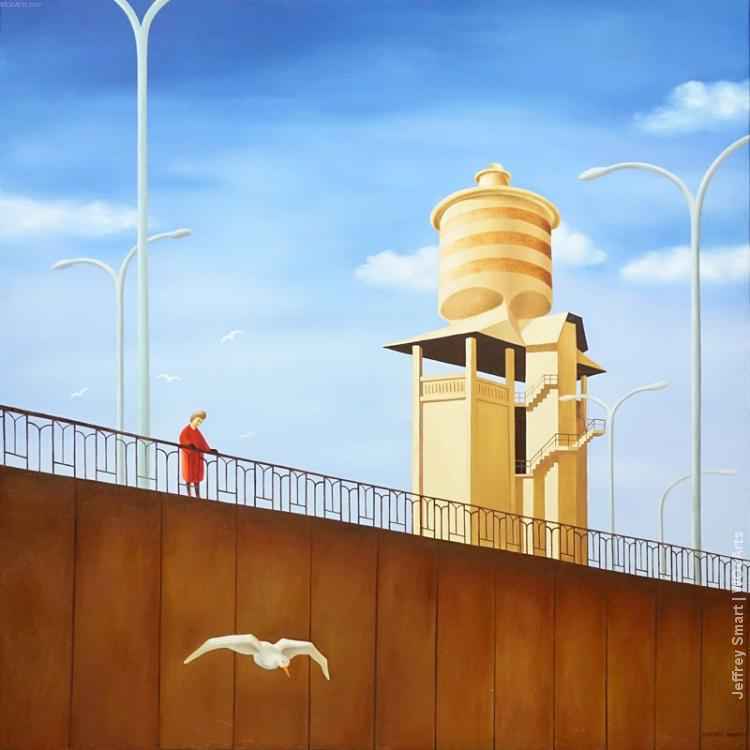
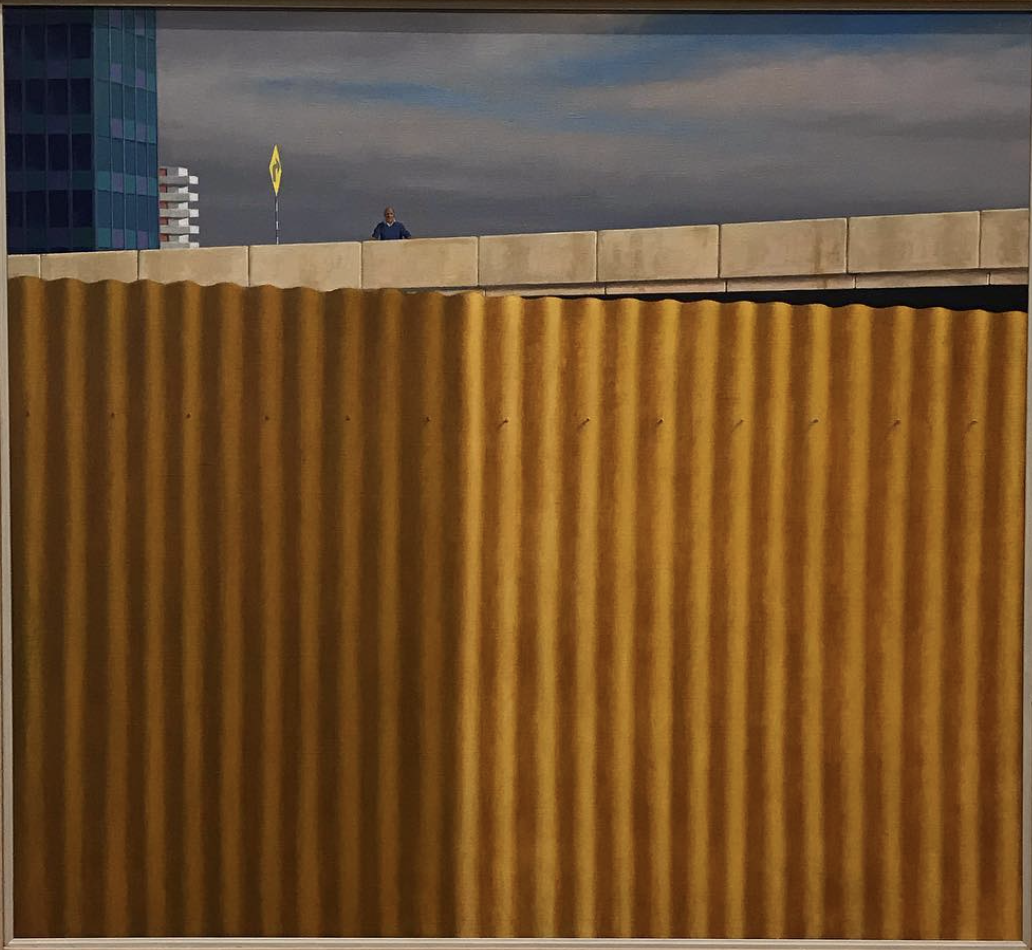
The persons in Jeffrey Smart’s paintings are often small. The artist has given more weight to seemingly uninteresting objects like, for example, steps and staircases as in the Ball Game below; like corrugated iron, as in the Portrait of Clive James, and road signs and part of company logos in foreign languages, like in Richmond Park. When he wants something likeable in the foreground, he lets a seagull outshine Gustav Mahler’s wife.
He claims a person appears in a painting instead of a plant when he needs to give a sense of distance or magnitude or give his work the necessary balance. But by choosing the trivial before the persons, like corrugated iron or a seagull, he also made a statement.
Jeff observed people whom he found too concerned about themselves. He could refer to them as “number One”. Or, he acidly commented, “your story has touched my heart” if they paid too much attention to something trivial in their lives. Jeff was quick in accepting or not accepting a person. If he liked you, there were no limits to his praise or what he would do for you. But if he didn’t like you, he first clad you with a ridiculous name. “Charlie Blumenthal” was one such name I remember. Then he could scold and talk ill of that Charlie and only the few informed knew whom he ridiculed. He could have made Charlie into one of those spot-sized persons playing balls or sitting on the grass in Richmond Park. But he would hesitate to do this to somebody he regarded as superior and part of a cultural or economic elite
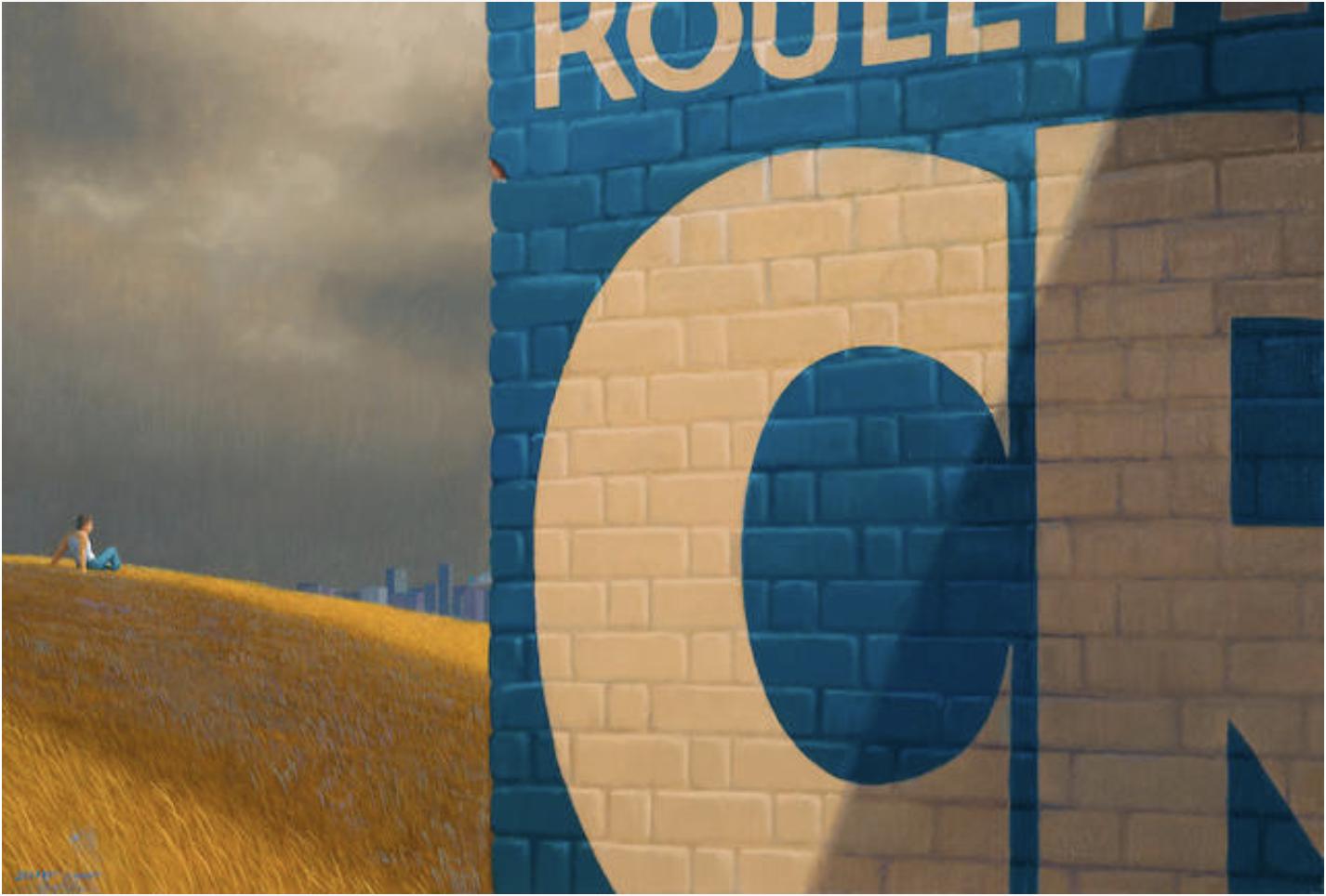

Richmond Park II, 1997
Alma Mahler feeding the birds, 1967-68
Portrait of Clive James, 19??
Ball Game
When I see the portrait of Clive James, I wonder how that person reacted to the honour of being chosen by Jeff to appear as hardly visible in a portrait. I know even close friends, like Justin O’Brien, ‘friend’ to Jeff during many years, could be seriously hurt by Jeff’s insensitive criticism and jokes. He saved no delicate issues, like Justin’s mother or his Irish ancestry, not to mention Justin’s painting.
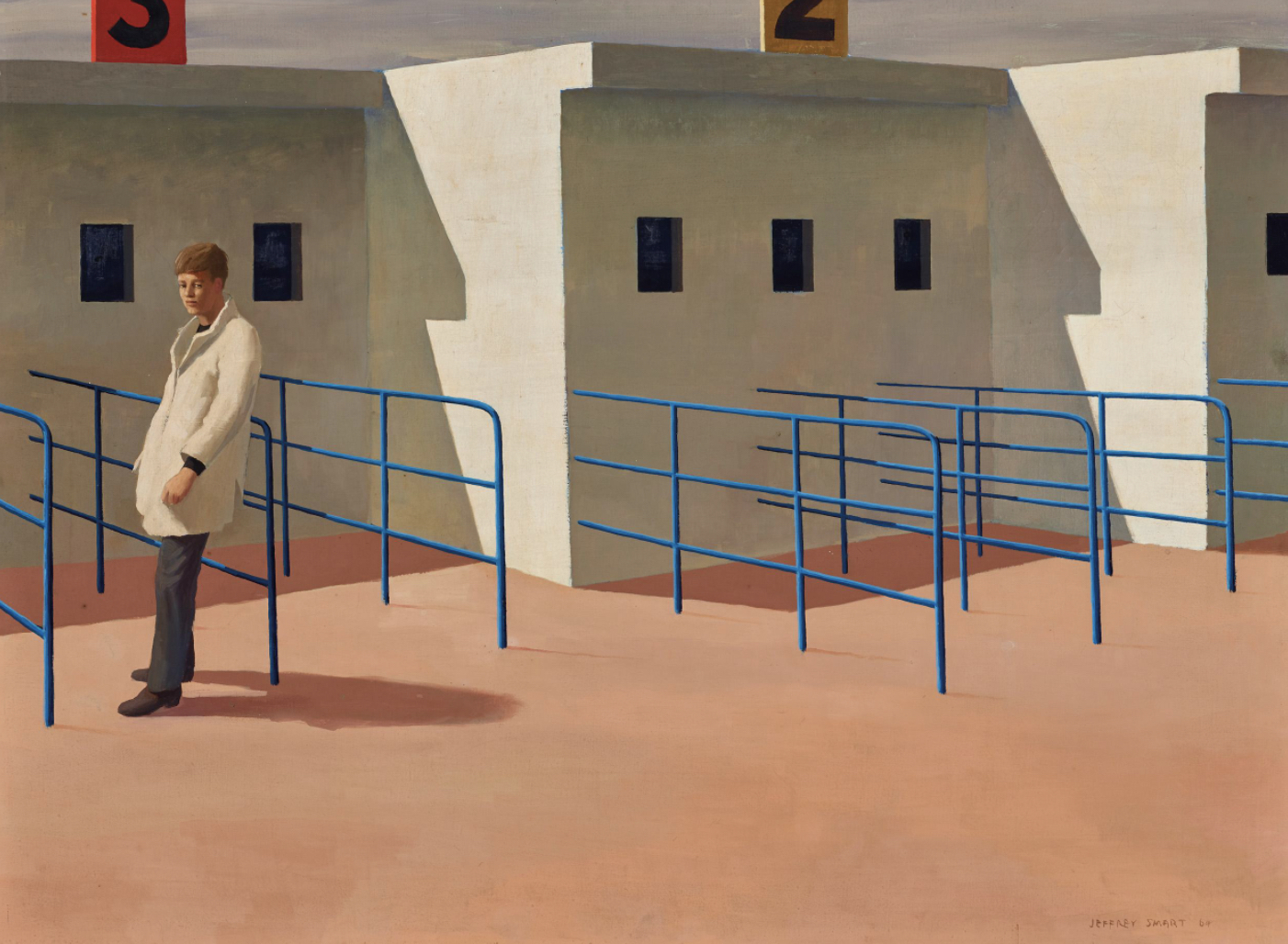
I also come to think of when I had been posing naked for Jeff for hours and during several days. When I found he had put me into a dark hut where only my right heel was lit, I was not happy. Later, I was compensated to a degree when that painting turned out to be the largest at the exhibition. And he had hun it close to the entrance so that nobody could miss it. Because of the size and its hanging, Jeff’s perpetuation of my teenage bum was well appreciated both by myself and by visitors to the inauguration. They included the Ambassadors to Italy from Australia and from the United Kingdom. Also, the Ambassadors to the Holy Sea were at the inauguration and the President of British Petroleum in Italy, BP Italiana
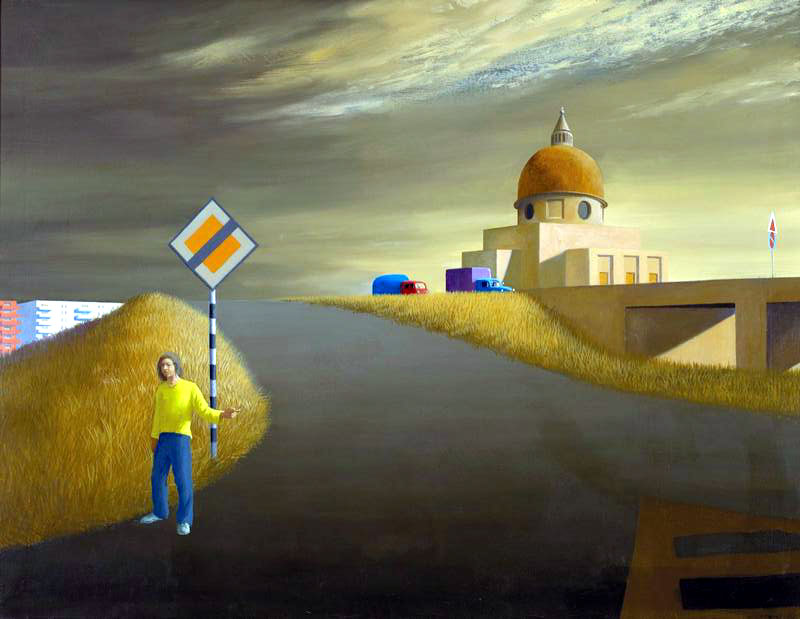

The Hitchhiker, 1972
Antibes, 2006
The New School II, 2004
Ticket Boxes, Catania, 1964
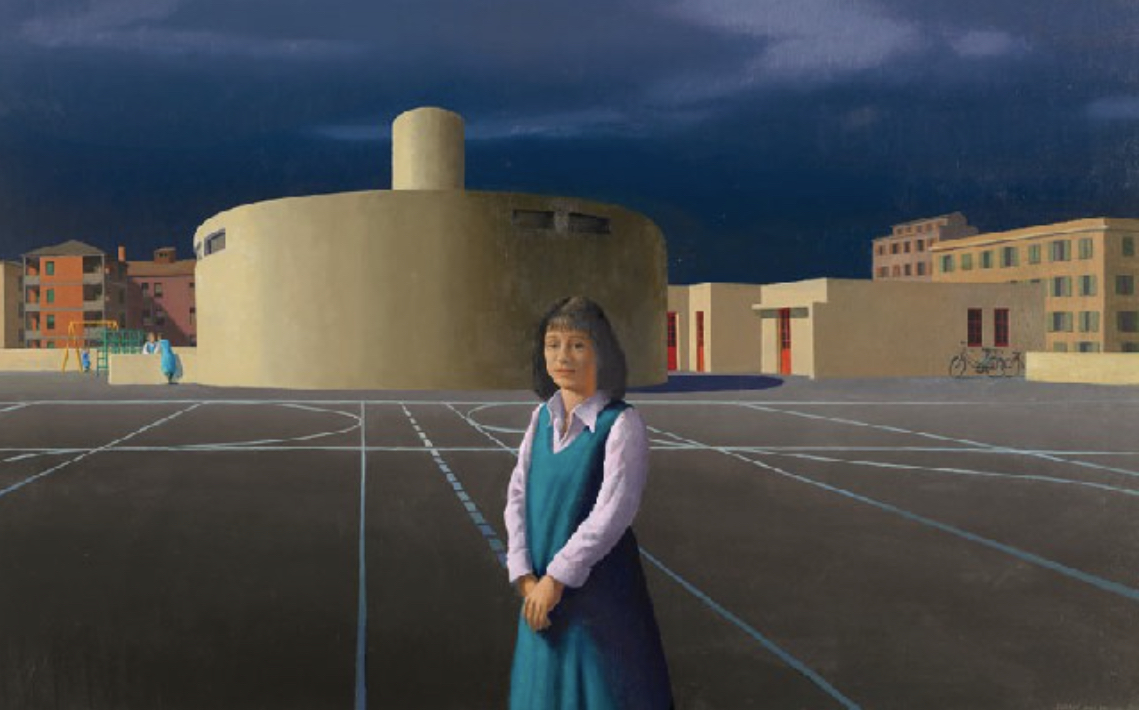
When the persons Jeff put in his paintings are in full size, they are usually alone, as we see in the four paintings below, which strecah over a period of forty years. And they usually not do anyrhing, or play a tennis ball towards a wall, or fun along a fence. Bending down over a fence or a wall looking down at somethings also a usual motive for a lonely person. I cannot help thinking of the little terrace Jeff and Ian made up on the roof at Via dei Riari in Rome, which was Jeff’s first and most intence love object at the time, where he invested most of his time and efforts and joys when he was not painting or cooking.
But here is gloom and the skies are black or dark. In Antibes we meet several old friends, the polka dot in both the cube and the kansten anlong the walk by the sea, the bald, fat man in a suite whom Jeff carries with him from Australia, where he appear as a garage owner (link), the lonely hitchiker who will never get a lift since there are no cars, no people and no life in the part of the world where this poor boy in the yellow shirt Jeff usually hands over to the few women on his paintings. He wants to fly away? He is young he doesn know that wherever he may go, there will alway be one person following him, himself, or tecum fugis as the Romans said. He is no seagull and bound to this earth even if he would find sombody to take him on a ride.
and don’t do anything, don’t play an instruemt, don’t eat. dont drink, don’t enjoy anybody’s company as you can see in the pictures below.
Why does Jeffery Smart paing t a girl who is new at her school? He loves to paint round erections, be they buildings or roads, and here is one and lines crossing his painting. If I do not see wroingly with my old eyes it looks as if the middle line on the schoolyard, which is interrumpted, would continue right into the schoolgirl’s most intimate body part. For some unknown reason she looks as gloomy and unattractive with her plain clothes that nobody whithout some specific reason would even spend some seconds photographing here, let alone spend hours for a painting. Whatever, gloom, solitude and a bit of fear are the allmarks of this painting. As a analysst one woud suspect that the sex of this objects has changed to make the assuption that this is the adrtist himself as you less common.
But people on Jeff’s painting are not always alone and gloomy and seemingly regrettable and on the next page we will meet some who are not totally lonely.