
Jeffrey Smart, Master of Successfully Restrained Anxiety

North Sydney, 1978
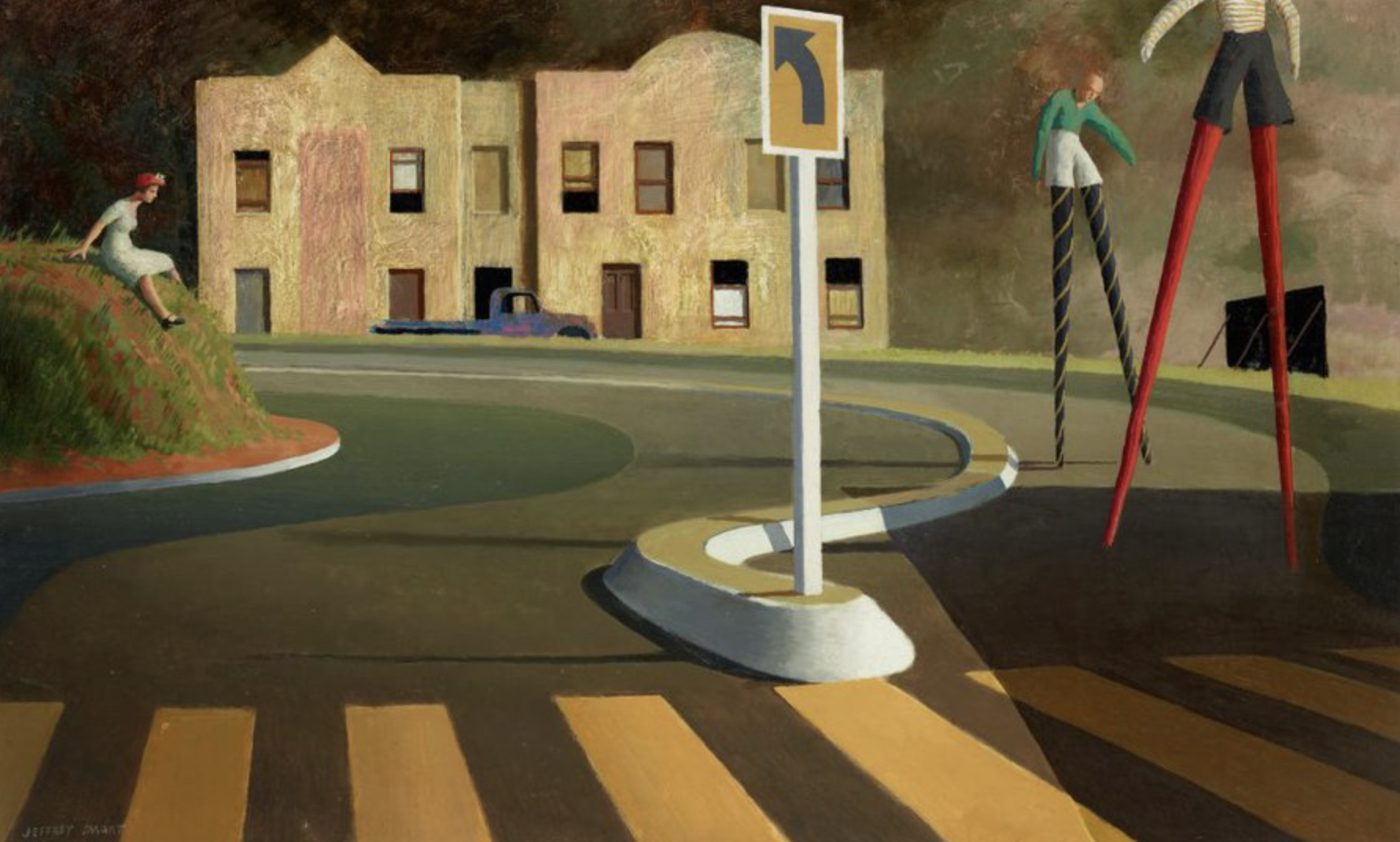
The Stilt Race, 1960
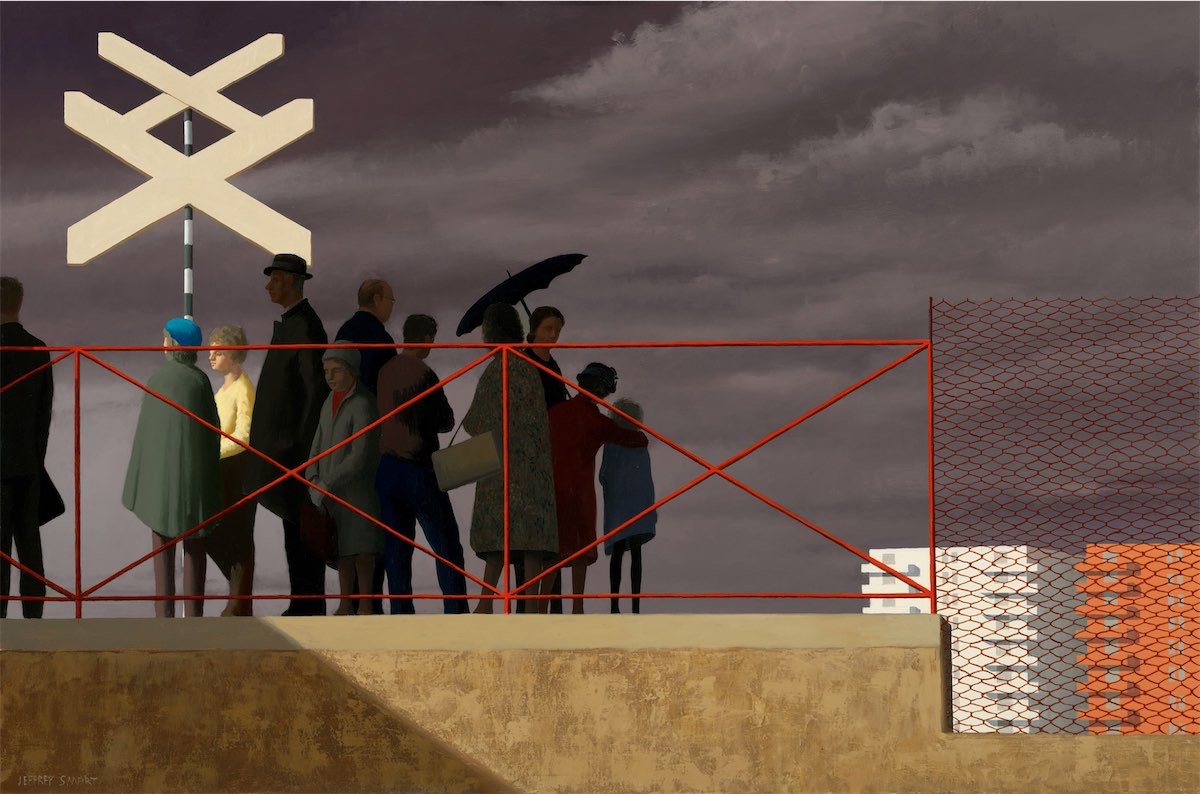
Waiting for the Train, 1969-70
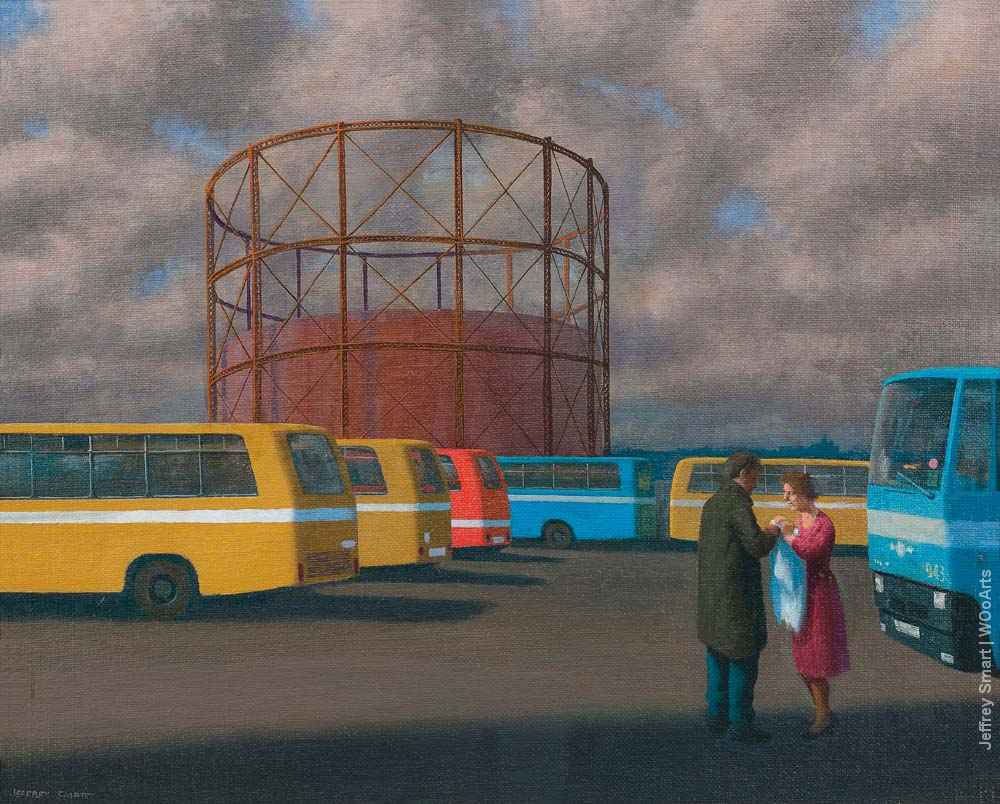
Mother and Child, 2000
Both on three of theses paintings and on the previous page the skies were dark or completely black and peopl could easily be seen as gloomy or at least disengaged. Having seen undreds of skies painted by Jeffrey Smart I think I have seen only two clarly bright and sunny skies, with Alma Mahler in the harbour and with the young man resting on the grass with his legs apart (a popular position for models on Jeff’s paintings, of which I was one) in North Sidney. Jeff is talking more clearly here. He has cared to make a shadow fall on half the green grass without showing what makes the shadow, but the shadow is there to stress and underline the brightness of the half of the grassarea wher the young man is lying under the bright sky and as a counterpoint tothe tall and exceptionally miighty office building in the bakground. This is not a portrait, but we know from his own words that Emre de Zan was modelling for this painting. So we know byt this painting not only who was lying with his lega apaart in front of Jeff when he painted, we also know that Jeff can make happy skiies, pleasantly erectef buildings, grass not disturbed by asphalt and people relaxed an drowned by pleasant sunligt. All the lonely darkness in most of his paintings are not there just by accident but as deliberate as the sun, the bright sky and the relaxed and pleased mood of this particular model.
Waiting for a train is a group of people, not waiting for Godot, but waiting in the dark under an unforgivably dark sky. The young boy is an exception, and thanks for Ian who lights up the day and night, here dressed in the yellow than Jeff oridnarilly likes to put on the few woman on his plates. I leave to an arty scolar, more at home with geometry than me, to spell out the significansis it this painting. But the atmosphere is clear, though presented in both enigmatic and surrealistic sign and setting.
The few, mostly lonely people you see in Jeff’s paintings, remind me of the citizens in previous USSR occupied nations. On the streets, in busses, in shops, even naked in popular saunas, nobody recognized the other, nobody said anything, there was no expression of any human emotion, all were scared to silence and a town like Tallinn in Estonia could in its medieval parts have similarities with the dead objects in Jeff’s paintings – even the young, always physically attractive young men in his paintings lack ordinary, normal human expressions. The individuals put into Jeff’s paintings are mannequins.
Man Under Big Brother's Control


Control Tower, 1969
The Listerners, 1966
The Picnick, 1980
The Observer II, 1983-84
Jeff didn't paint an idyllic Australia. When he came to Rome he got a chock watching the new suburbs growing like mchsrooms or mould around the former centre of the whole known world. He writes that he liked what he saw, a modern Italy with a perfectly smooth autostrada between Rome and Florence where he was transported at a speed of over 150 km/h every weekend in a cozy Bentley with delighted company of an economic or cultural elite from the Roman disaspora.
If you are not familiar with the Roman suburb you can get som glimps of it both in Fellini's La Dolce Vita, but even more in Mama Roma by Pier Paolo Pasolini, both much worth watching again. These suburbs are seen, usually at a distance on several of Jeff's paintings, but mainly as a poethora of apartment blocks of usually low quality. They grew up around big cities in most European countries and also in the USSR. There the apartment doors were made of pressed paper and the lifts in these aparment bildings were used both for micturation and defaication. Light bulbs in the stairs were taken by clever youngssters to sell at the market to earn some Rubles. I lived in such an apartment in newly constractued flat buildings on the Riviera dei Fiori ouside San Remo while Jeff was living in Rome on Vie dei Riari, which was quite another cup of tea, with a splended little terras, where on could cultivate one's favourite flowers.
This is one of the themes in Jeff's production. The often huge devices looking like surveilling instruments, and Jeff has been completely aware of this, just look at their names, Control Tower, The Listerners, and the Observer. The radar in The Listeners has been referred to as a Surveilling radar, and The Listerners, who are they? There is onlly one chap visible, who are Listerners if not those behind the surveilling radar. And the Observer... who is he observing, naked younsters on a beach? And when was this chap painted? In 1984. This is Jeffrey Smart's Big Brother in 1984. Shall we belive it to be a coinsidence that this man appear with this loudspeaker from old Hitler times in 1984. This could have served as a cover to Orwell's book and the loadspeaker could have been named His Fuhrer's Voice. But, look, the hundreds of thousands living in the suburb behind it, stuffed lake beheaded Sardines in the concrete boxes in the distance, light blue in this picture, as worn jeans, othewise pink and equally seductive at a long distance but sthinking of old urine if you'd dare to put your nose into any of the boxes.
And what do we do in the meantime? We have a picknick, behind a think wall of nature, so thick we feel protected, but look, big brother build his instruments even higher, so you will still be seen. So don't try any honky ponky Big Brother might not approve of, like Google today, which gets into your home and your desk all day long to tell you what to do and not to do. Words you may use or not, and thoughts you may have or not. Google doesnt arrange book burning on the streets of Berlin, they eliminate what for them is 'entartete' productions and opinions they and YouTube and Twitter will not accept on their way to world dominance.
It is my conviction that Jeff had experiened the intrution, even if still only in small scale when he was still alive. Buty he forcasted the situation for the human being.